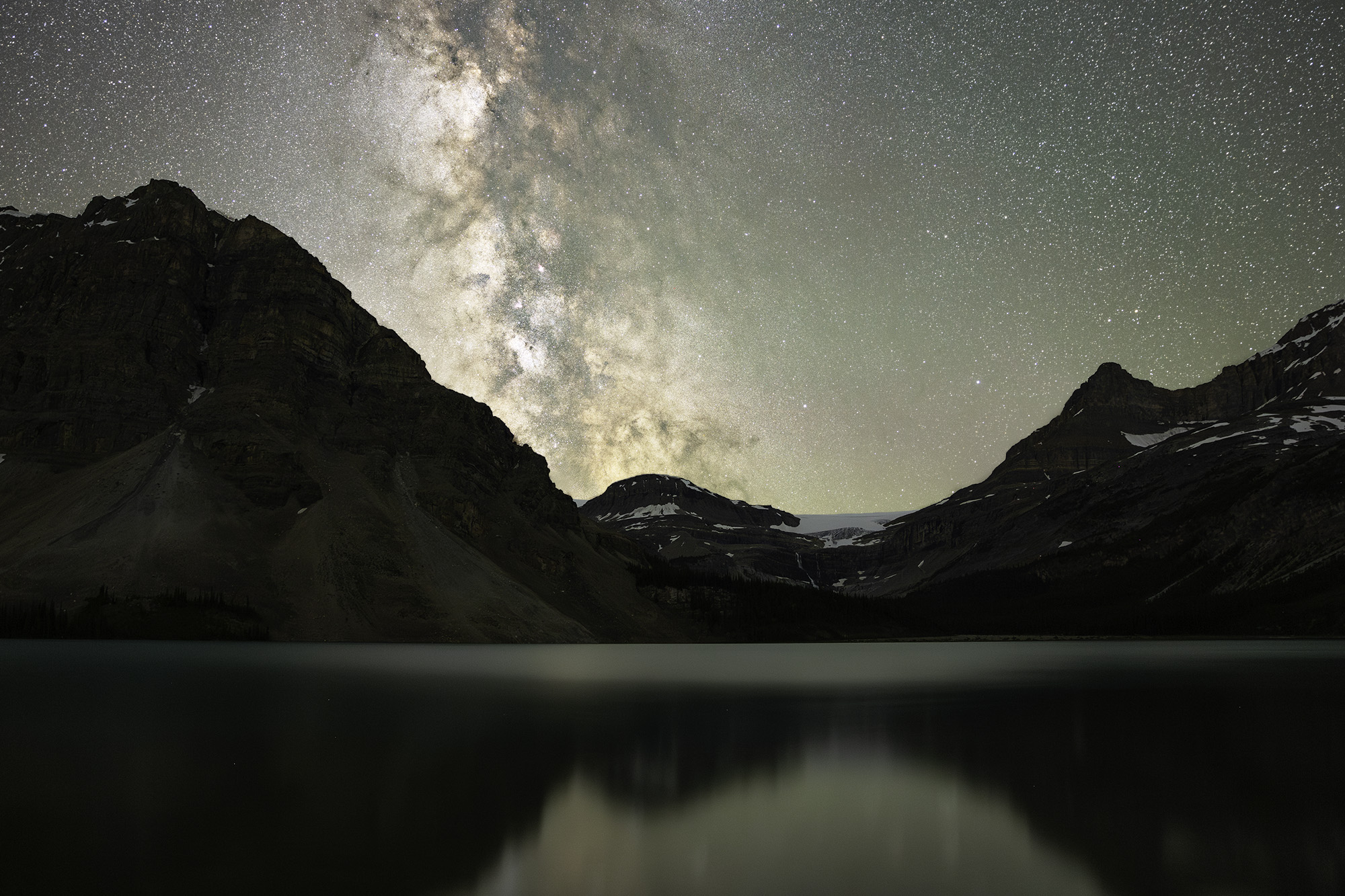
Bow Lake Milky way
Price range: $125.00 through $850.00
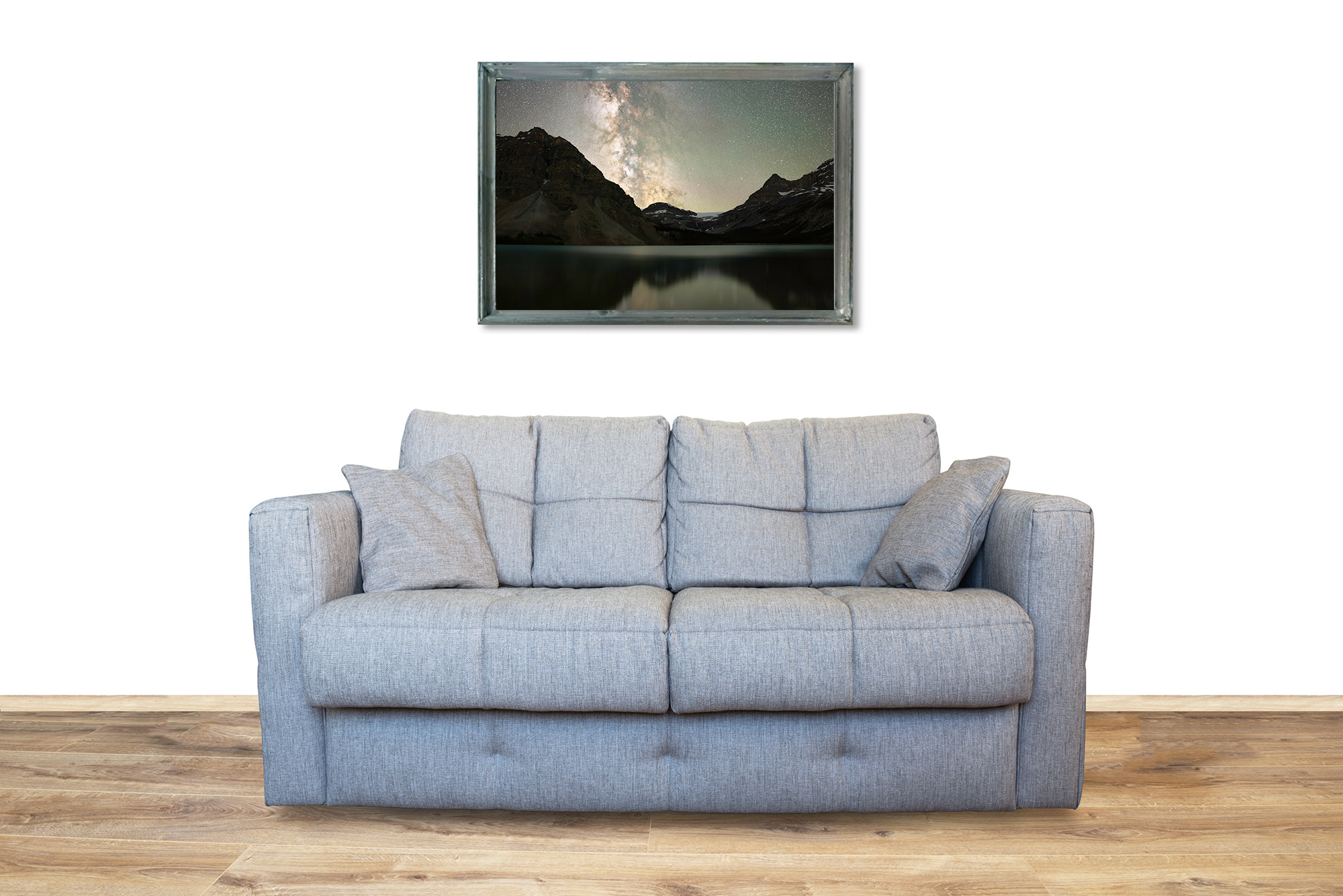
Bow Lake Milky-way can be printed on Fine Art Paper, Canvas, Metallic or Acrylic. Fine Art print is available in four materials in five sizes; Frames are available via special order; Prices are available on request; Shipping is added on top of special orders.
Description
Bow Lake Milky Way can be printed on Fine Art Paper, Canvas, Metallic or Acrylic. Fine Art print is available in four materials in five sizes; Frames are available via special order; Prices are available on request; Shipping is added on top of special orders.
This is a limited print; there are only 99 prints available, no matter the material each person selects. When purchased, you receive a COA (Certificate of Authenticity) and a laser hologram sticker with a unique serial number.
Capturing the Bow Lake Milky Way Magic
Experience the enchanting beauty of Bow Lake as you embark on a stargazing adventure. Capture the breathtaking Milky Way and create unforgettable memories.
The Science Behind the Milky Way
The Milky Way galaxy is an awe-inspiring spiral galaxy that contains our solar system. Stretching between 100,000 and 200,000 light-years in diameter, it houses between 100 and 400 billion stars, countless planets, and an array of celestial phenomena. When we gaze up at the night sky, the bright band of stars and dust that we see is just a small portion of this massive galaxy. The Milky Way’s central bulge, filled with older, reddish stars, contrasts beautifully with the spiral arms where younger, hotter stars reside. This juxtaposition creates the mesmerizing sight that stargazers around the world cherish.
Understanding the Milky Way’s structure helps us appreciate its beauty even more. The galaxy’s spiral arms are dotted with star-forming regions, where new stars are born from vast clouds of gas and dust. These regions emit a faint glow, adding to the Milky Way’s enchanting appearance. The dark lanes we see cutting through the Milky Way are actually dense clouds of interstellar dust that block light from the stars behind them, creating the intricate patterns that captivate our eyes.
The Milky Way is not just a visual marvel; it’s also a key to understanding our place in the universe. Observing it allows scientists to study the galaxy’s composition, formation, and evolution. For amateur stargazers, each glimpse of the Milky Way is a reminder of the vastness of the cosmos and our connection to it. Whether you’re an astrophysicist or a casual observer, the Milky Way offers a window into the boundless wonders of the universe.
Best Times of Year for Stargazing at Bow Lake
Timing is crucial when planning a stargazing trip to Bow Lake. The best times of the year to observe the Bow Lake Milky Way are during the warmer months, from late spring to early fall. During this period, the Milky Way’s core is visible in the night sky, providing the most spectacular views. In the northern hemisphere, the Milky Way is best seen from May to September, with peak visibility occurring in July and August.
Clear skies are essential for a successful stargazing experience. Bow Lake, located in Banff National Park, offers some of the clearest skies in Canada, thanks to its high elevation and minimal light pollution. However, weather conditions can be unpredictable, so it’s important to check the forecast before heading out. Summer nights tend to be warmer and more comfortable for stargazing, but fall nights can offer crisp, clear skies that are perfect for capturing the Milky Way.
Moon phases also play a significant role in stargazing. The best time to observe the Milky Way is during the new moon, when the sky is darkest and devoid of moonlight. A full moon can wash out the stars and make it difficult to see the Milky Way, so plan your trip around the new moon or the week leading up to it. By choosing the right time of year and paying attention to the moon’s phases, you can maximize your chances of witnessing the Milky Way’s magic at Bow Lake.
Essential Gear for Stargazing
To fully enjoy your stargazing adventure at Bow Lake, having the right gear is essential. First and foremost, you’ll need a good pair of binoculars or a telescope. Binoculars are portable and easy to use, making them ideal for beginners. Look for binoculars with a magnification of at least 7×50, which means they have a magnification power of 7 and an objective lens diameter of 50 millimetres. This combination allows for a bright and clear view of the night sky.
A telescope can provide more detailed views of celestial objects, but it’s important to choose one that suits your needs and experience level. For beginners, a refractor or reflector telescope with an aperture of at least 4 inches is a good starting point. Equatorial mounts are recommended for their ability to track the movement of stars, which is especially useful for long exposure photography. Additionally, a sturdy tripod is essential for keeping your binoculars or telescope steady while observing the stars.
Other essential gear includes warm clothing, as temperatures can drop significantly at night, even in the summer. Dress in layers and bring along a blanket or sleeping bag for added warmth. A red flashlight is useful for navigating in the dark without affecting your night vision. Red light is less disruptive to your eyes, allowing you to adjust more quickly to the darkness. Finally, bring a star chart or a stargazing app to help you identify constellations and other celestial objects. With the right gear, you’ll be well-prepared to make the most of your stargazing experience at Bow Lake.
Tips for Capturing Stunning Milky Way Photos
Photographing the Milky Way requires a combination of the right equipment, settings, and techniques. A DSLR or mirrorless camera with manual settings is essential for capturing high-quality images of the night sky. Start by using a wide-angle lens with a focal length between 14mm and 24mm, which allows you to capture a broad expanse of the Milky Way. A fast aperture (f/2.8 or lower) is also important for gathering as much light as possible in low-light conditions.
When setting up your camera, use a sturdy tripod to keep it steady during long exposures. Set your camera to manual mode and adjust the ISO to a high value, typically between 1600 and 3200. This increases the camera’s sensitivity to light, allowing you to capture more detail in the night sky. Next, set the aperture to its widest setting (f/2.8 or lower) and the shutter speed to between 15 and 30 seconds. Any longer, and the stars will begin to trail due to the Earth’s rotation.
Focusing in the dark can be challenging, so switch your lens to manual focus and use live view to zoom in on a bright star. Adjust the focus until the star appears sharp. Once everything is set, take a test shot and review the image to ensure proper exposure and focus. Experiment with different settings and compositions to find what works best for you. Post-processing is also a crucial step in enhancing your Milky Way photos. Use software like Adobe Lightroom or Photoshop to adjust the exposure, contrast, and colours, bringing out the full beauty of the Milky Way.
The Role of Light Pollution in Stargazing
Light pollution is one of the biggest challenges for stargazers, especially those living in urban areas. It refers to the excessive and misdirected artificial light that brightens the night sky, making it difficult to see stars and other celestial objects. Streetlights, billboards, and building lights all contribute to light pollution, which can wash out the Milky Way and obscure fainter stars. To experience the full beauty of the night sky, it’s essential to find a location with minimal light pollution.
Bow Lake is an excellent stargazing destination due to its remote location and low levels of light pollution. Situated in Banff National Park, it offers some of the darkest skies in North America. The park is committed to preserving its dark skies by implementing measures such as shielding outdoor lights and using low-intensity bulbs. These efforts help create an ideal environment for stargazing and astrophotography.
Understanding the impact of light pollution can also inspire us to take action in our own communities. Simple changes, such as using outdoor lights with motion sensors, installing shielded fixtures, and advocating for dark sky-friendly policies, can make a significant difference. By reducing light pollution, we can help preserve the night sky for future generations and ensure that everyone has the opportunity to experience the wonder of stargazing.
Local Stargazing Events and Workshops
Bow Lake and the surrounding areas offer a variety of stargazing events and workshops that cater to both beginners and experienced astronomers. These events provide a unique opportunity to learn more about the night sky, improve your stargazing skills, and connect with fellow enthusiasts. Many of these events are hosted by local astronomy clubs, national park organizations, and educational institutions.
One popular event is the annual Jasper Dark Sky Festival, held in nearby Jasper National Park. This festival features a range of activities, including guided stargazing sessions, astronomy talks, and workshops on astrophotography. Participants can learn from experts, use state-of-the-art telescopes, and enjoy the pristine dark skies of the Canadian Rockies. The festival is family-friendly and offers something for everyone, from novice stargazers to seasoned astronomers.
In addition to festivals, many local observatories and astronomy clubs offer regular stargazing nights and educational programs. These events often include telescope viewings, lectures, and star parties, where participants can share their knowledge and experiences. By attending these events, you can gain valuable insights, make new friends, and deepen your appreciation for the night sky. Whether you’re looking to improve your astrophotography skills or simply enjoy a night under the stars, local stargazing events and workshops are a fantastic way to enhance your experience.
Safety Tips for Stargazing at Night
While stargazing is a peaceful and enjoyable activity, it’s important to prioritize safety, especially when venturing out to remote locations like Bow Lake. One of the most crucial safety tips is always to go stargazing with a companion. Having a buddy ensures that you have someone to assist in case of an emergency and makes the experience more enjoyable. If you must go alone, inform someone of your plans and expected return time.
Dress appropriately for the weather, as temperatures can drop significantly at night. Wear layers of clothing, and bring along a hat, gloves, and warm socks. It’s also a good idea to pack a blanket or sleeping bag for added warmth. Make sure to bring plenty of water and snacks to stay hydrated and energized throughout the night. A first aid kit is essential for handling minor injuries, and a fully charged cell phone can be a lifeline in case of emergencies.
Navigating in the dark can be challenging, so bring a red flashlight to help you see without affecting your night vision. Familiarize yourself with the area during daylight hours to avoid getting lost at night. Be aware of wildlife in the area and take necessary precautions, such as making noise to alert animals of your presence. Finally, respect the environment by packing out all trash and leaving no trace of your visit. By following these safety tips, you can ensure a safe and enjoyable stargazing experience at Bow Lake.
Other Celestial Wonders to Observe at Bow Lake
While the Milky Way is undoubtedly the star attraction, Bow Lake offers the opportunity to observe a variety of other celestial wonders. One of the most mesmerizing sights is the aurora borealis, or northern lights. This natural light display occurs when charged particles from the sun interact with the Earth’s magnetic field, creating vibrant colours that dance across the sky. Bow Lake’s northern location and dark skies make it an excellent spot for witnessing this breathtaking phenomenon.
In addition to the northern lights, Bow Lake is an ideal location for observing meteor showers. Throughout the year, several meteor showers grace the night sky, with the Perseids in August and the Geminids in December being among the most spectacular. During these events, dozens of meteors can be seen streaking across the sky, providing a dazzling display for stargazers. To maximize your chances of seeing meteors, find a comfortable spot, lie back, and keep your eyes on the sky.
Planets are another exciting target for stargazers. Depending on the time of year, you can observe planets such as Jupiter, Saturn, Mars, and Venus. Jupiter’s four largest moons, known as the Galilean moons, are visible with binoculars or a small telescope. Saturn’s iconic rings can also be seen with a telescope, offering a captivating view. By exploring the night sky at Bow Lake, you can discover a wealth of celestial wonders that go beyond the Milky Way.
Conclusion: Embracing the Night Sky at Bow Lake
Stargazing at Bow Lake is an unforgettable experience that lets you connect with the cosmos and witness the breathtaking beauty of the Bow Lake Milky Way. By understanding the science behind the Milky Way, choosing the best times of year for stargazing, and bringing the right gear, you can make the most of your adventure. Capturing stunning Milky Way photos requires practice and patience, but the results are well worth the effort.
Light pollution is a significant challenge for stargazers, but Bow Lake’s remote location offers some of the darkest skies in North America. Attending local stargazing events and workshops can enhance your experience and provide valuable insights. Safety is paramount when stargazing at night, so be sure to take the necessary precautions to ensure a safe and enjoyable outing.
Beyond the Milky Way, Bow Lake offers the chance to observe other celestial wonders, such as the northern lights, meteor showers, and planets. Each night under the stars is an opportunity to deepen your appreciation for the universe and create lasting memories. Embrace the night sky at Bow Lake, and let the magic of the Milky Way inspire and captivate you.
You may also like…
-
Herbert Lake
Price range: $125.00 through $850.00 Select options This product has multiple variants. The options may be chosen on the product page -
Mount Assiniboine Milky-way
Price range: $125.00 through $850.00 Select options This product has multiple variants. The options may be chosen on the product page


Related products
-
Black Bear
Price range: $125.00 through $850.00 Select options This product has multiple variants. The options may be chosen on the product page -
Bison Race
Price range: $125.00 through $850.00 Select options This product has multiple variants. The options may be chosen on the product page -
Young Bison in Snowy Woodlands
Price range: $125.00 through $850.00 Select options This product has multiple variants. The options may be chosen on the product page


