Most photographers obsess over gear, shutter speed, and that golden-hour window. But the moment you decide to bring an image off the screen and onto a wall, a completely different set of decisions determines whether the result looks stunning or disappointing. This guide breaks down everything that goes into highest quality printing for fine art nature photography – from ink chemistry and paper selection to colour management and archival longevity – so you can make informed choices whether you’re collecting art, decorating a home, or preparing your own images for print.
Answering Your Question Up Front: What Is “Highest Quality Printing”?
When we talk about highest quality printing in the context of fine art nature photography, we’re referring to the convergence of four things: sharp details rendered at the correct resolution, accurate and vivid colour reproduction, archival permanence measured in decades (not years), and presentation that protects and enhances the image. A print that nails all four is gallery-grade. A print that misses even one often ends up looking flat, fading prematurely, or warping behind cheap glass.
How does a premium fine art print differ from a drugstore 8×10 or a budget online photo printing service? The gap is enormous. Budget prints typically use dye-based inks on thin, resin-coated paper – materials that can show visible fading within a decade under normal indoor light. Premium photo prints use pigment-based inks on heavy, acid-free substrates like cotton rag, baryta, or coated aluminum panels. The colour is managed from calibrated monitor to final output using ICC profiles. Every print is visually inspected. The result is a piece of wall decor that holds its colour and detail for generations, not just seasons.
Throughout this guide, you’ll encounter key concepts – archival papers, pigment versus dye inks, colour-managed workflows, and professional mounting options like metal prints, acrylic prints, and framed prints on fine art paper. At Jardene Photography, all wall prints are produced via ArtBeat Studios using gallery-grade processes designed for collectors and interior designers who expect exceptional quality from every piece.
Why Print Quality Matters More Than Ever in the Digital Age
Most digital photos today never leave a phone. They’re compressed, filtered, scrolled past, and eventually buried under thousands of newer files. Social feeds reduce a carefully composed landscape to a thumbnail competing with ads and memes. Your favourite photos deserve more than that.
High-quality photo prints matter because they transform fleeting images into tangible objects – interior décor that anchors a room, heirlooms you can pass to loved ones, and exhibition pieces that prove a photographer’s craft. Consider the difference between swiping past a 1080-pixel-wide aurora photo on Instagram and standing in front of a 30×45″ metal print of the same scene. In print, you see snow texture on the foreground peaks, subtle green-to-purple colour gradients in the aurora curtain, and pinpoint stars that simply vanish at screen resolution. Those sharp details only fully appear when the file is printed on the right substrate, at the right size, with the right inks.
Serious collectors and galleries still judge a photographer’s work by the overall quality of the physical print, not just the digital images. A photograph that looks impressive on a monitor but arrives as a muddy, undersaturated print loses credibility fast. That’s why the printing process matters as much as the capture.
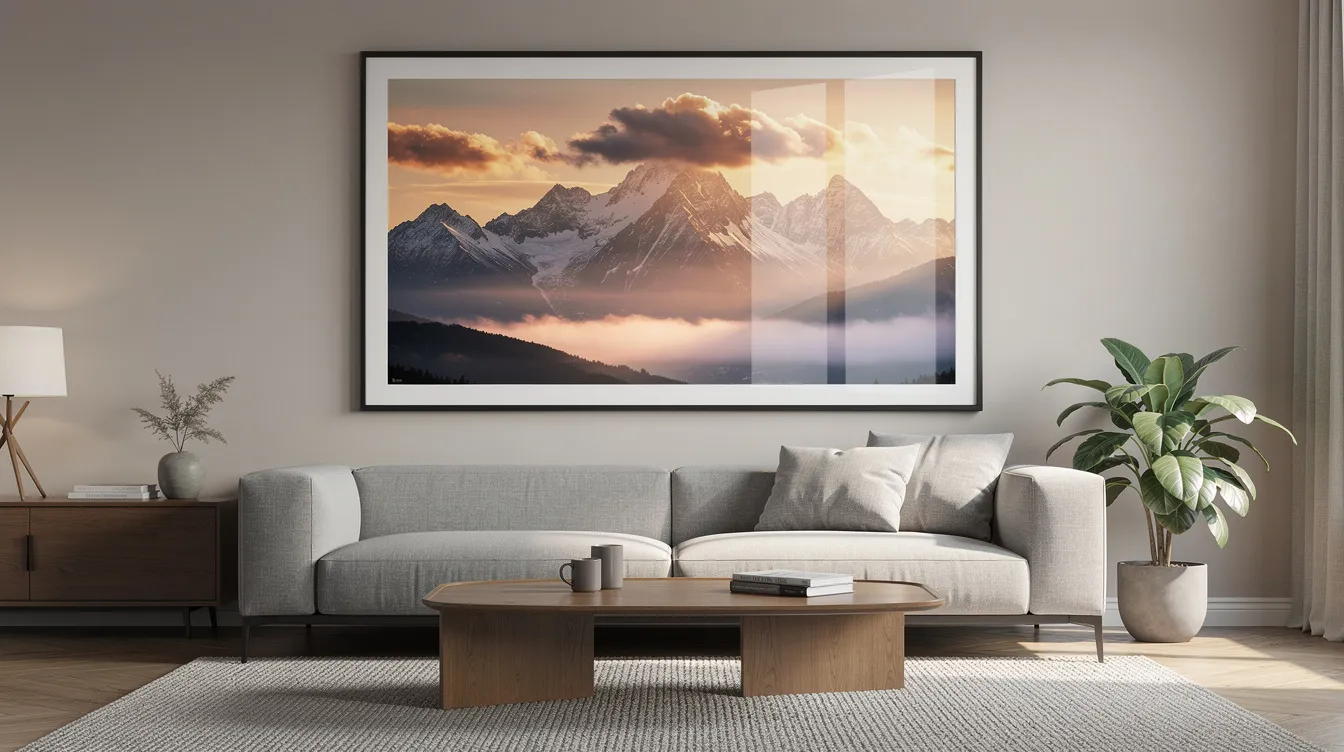
How Jardene Photography Approaches Highest Quality Printing
Jardene Photography specializes in fine art prints of Alberta, the Canadian Rockies, bison, and wildlife – subjects that demand extreme dynamic range, accurate earth tones, and the kind of micro-contrast that reveals individual blades of prairie grass or the texture of bison fur. Every image in the Photography Shop is produced to gallery standards.
Print production happens in collaboration with ArtBeat Studios in Calgary. This isn’t a matter of uploading a JPEG to an anonymous print lab and hoping for the best. Files are calibrated and proofed before production. Substrates and inks are archival-grade. Each print is inspected before it ships. You can review exactly what’s included with every order on the website.
Core quality commitments include calibrated master files, soft proofing against lab profiles, use of archival materials across all print options, and a 100% Satisfaction Guarantee on show and online orders. And because 15% of profits are donated to the Alberta Institute for Wildlife Conservation, every purchase also supports the landscapes and animals in the photographs themselves.
Key Ingredients of the Highest Quality Photo Prints
Think of this as a checklist. If a print lab or photographer can tick every item below, you’re looking at pro-quality output. If several are missing, you’re paying for something that won’t hold up.
- Resolution and file quality. The master file should originate from a RAW capture, processed in 16-bit, and exported as a full-resolution TIFF or high-quality JPEG. Image resolution for professional prints should be at least 300 PPI for close-viewing sharpness.
- Colour management. The workflow uses a wide-gamut working space (Adobe RGB or ProPhoto RGB), hardware-calibrated monitors, and lab-specific ICC profiles for soft proofing.
- Archival papers and substrates. Cotton rag, baryta, or professional-grade photo paper – acid-free, lignin-free, rated for decades of display. Heavyweight fine-art papers lie flat and handle high ink loads without warping. Silver Halide printing technology is over 100 years old and remains a benchmark for traditional photo prints, while modern inkjet giclée methods have expanded what’s possible.
- Pigment inks. Pigment-based inks provide superior archival longevity and chemical stability compared to dye inks. High-end printers use 10–12 ink channels for expanded gamut.
- Professional mounting. Metal panels, acrylic face-mounts, archival framing with UV-protective glazing – not a poster thumbtacked to drywall. Canvas prints can be wrapped around a wooden frame for a clean, frameless look if that suits the space.
- Quality control. Visual inspection under controlled lighting, comparison against proof, and willingness to reprint when something isn’t right.
Screen printing produces exceptionally bold and vibrant colours on various substrates, but for photographic reproduction, giclée and dye-sublimation remain the dominant technologies in fine art.
Understanding Resolution: How Many Megapixels for Large Prints?
Resolution confusion is one of the most common roadblocks when people order prints. Here’s how it works in practice.
A digital photo is made of pixels. Print resolution is expressed as pixels per inch (PPI or DPI). At 300 DPI – the standard for close-viewing sharpness – a 24-megapixel file (6000 × 4000 pixels) produces a print roughly 20 × 13.3 inches. Drop to 180 DPI, and that same file comfortably fills a 33 × 22″ frame. At 150 DPI, you’re looking at roughly 40 × 27″.
Does that mean you need an 80-megapixel sensor for a 30×45″ print? Not necessarily. Viewing distance matters enormously. A print hung above a sofa is typically viewed from three to four metres. At that distance, 200 DPI delivers image quality indistinguishable from 300 DPI. For Jardene Photography’s large prints, files are prepared to meet or exceed these thresholds, and panoramic stitches push effective resolution well beyond single-frame limits.
Mpix offers smartphone-friendly print sizes like 4×5.3 inches – perfectly fine for small prints from phone cameras. But for large prints destined for a living room wall, the source file needs to be captured with quality printing in mind from the start.
Colour Accuracy and Consistency: Why Colour Management Matters
You’ve probably experienced this: a photo looks vivid and warm on your laptop, but the print arrives looking dull or shifted toward blue. The culprit is almost always a colour management gap somewhere in the chain.
Professionals achieve the highest print quality by optimizing colour management and workflows. A colour-managed workflow starts with a hardware-calibrated monitor (devices like X-Rite i1Display or Datacolor Spyder, recalibrated monthly). The photographer edits in a wide-gamut colour space – Adobe RGB for most print work, or ProPhoto RGB for maximum headroom. Before sending files to the print lab, the image is soft-proofed using the lab’s ICC profile, which simulates how colours will render on a specific paper with specific inks. Using ICC profiles ensures predictable color reproduction in printing.
At Jardene Photography, master files are prepared with this entire chain in mind. Skin tones in wildlife portraits, the subtle blue-greens of glacial lakes, and the electric hues of aurora curtains all require accurate colour translation from screen to substrate.
Practical tips for anyone evaluating prints: view them under neutral daylight or 5000K lighting, avoid judging colour under warm tungsten bulbs, and if your monitor is set to a “vivid” or “dynamic” mode, what you see on screen is not what any lab will produce. For critical projects, a test print is always worth the investment.
Paper Types and Surfaces for High-Quality Photo Prints
Print quality is influenced by paper type used – more than most buyers realize. Here’s a breakdown of the main categories and when each shines.
- Glossy. Glossy prints have a shiny finish that enhances colour vibrancy. Glossy papers generally produce the widest colour gamut and deepest blacks, making them ideal for aurora images, vivid sunsets, and high-contrast scenes. The trade-off is glare and fingerprint visibility. Prints on glossy paper have more vibrant colours than any other surface.
- Lustre / Satin. Lustre prints have a slight sheen without high reflectiveness – a practical middle ground. Good colour saturation, reduced glare, and a subtle e surface texture that adds depth. Popular for photo enlargements displayed in well-lit rooms.
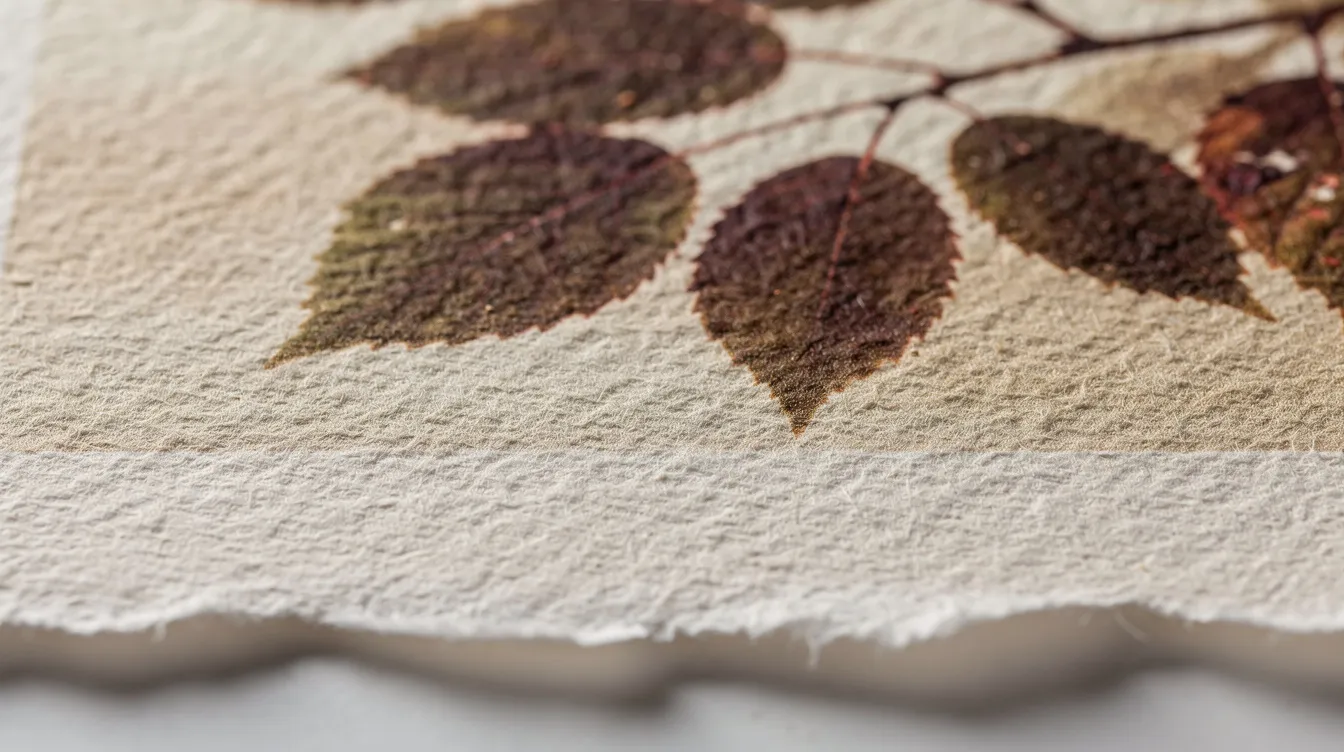
- Matte cotton rag. Soft, textured, and completely glare-free. Matte cotton rag excels at rendering animal fur, feather detail, and misty atmospheric scenes. It’s the classic choice for portrait style prints and black-and-white work. The finish is often described as painterly.
- Baryta-style papers. Coated with barium sulphate to emulate traditional silver halide fibre-based prints: deep blacks, rich midtones, smooth gradations. Excellent for high-contrast mountain landscapes.
Mpix prints on Kodak Endura paper for rich colours, and Printique offers a range of paper options including Kodak Endura and Fujifilm Matte papers – both solid choices for consumer-level photo print options. For fine artwork, however, papers like Hahnemühle Photo Rag (308 gsm cotton rag) or Canson Platine Fibre Rag represent a step up in both feel and archival permanence.
Jardene Photography typically recommends specific paper type selections per image – deep blacks for night skies, subtle texture for snowy landscapes – because no single surface suits every subject.
Metal Prints: When to Choose Them and What “High Quality” Means
Metal prints use dye-sublimation technology to infuse images directly into a coated aluminum panel. The result is a rigid, moisture-resistant piece of wall art with vivid colour pop and striking luminosity. Metal prints are available in glossy or matte finishes, each suited to different subjects and environments.
What separates a premium metal print from a cheap one? Panel brand matters – ChromaLuxe panels are the industry standard. Coating quality affects colour gamut and scratch resistance. LED UV printing allows for crisp details on non-porous surfaces, but dye-sublimation remains the dominant method for photographic metals. Hanging hardware should be robust; flimsy clips can’t safely hold a 30×45″ aluminum panel.
From Jardene’s catalogue, consider a glossy metal print of Moraine Lake Sunrise – the turquoise water and orange peaks demand maximum saturation. Compare that with a matte metal of a stormy prairie scene, where reduced glare lets the drama of the clouds speak without distraction.
Metal prints are ideal for bright, contrasty images, modern interiors, and high-humidity spaces like kitchens or bathrooms where paper would be vulnerable. When the subject calls for soft texture or traditional gallery presentation, another medium may serve better.
Fine Art Paper Prints: The Classic Choice for Collectors
There’s a meaningful difference between a standard photo lab print and a true fine art giclée print. Giclée printing utilizes high-resolution inkjet technology with pigment-based inks on archival substrates. The result is a print with tonal subtlety that dye-based processes simply cannot match.
Giclée prints can last over 100 years when using acid-free substrates. On cotton rag paper, shadow detail is preserved without the “blocked” look common in cheaper prints, and highlight transitions stay smooth rather than blowing out. This makes giclée the preferred medium for collectors and galleries who buy art as a long-term investment.
Consider a misty forest scene from Kananaskis – the soft gradations between fog, tree bark, and snow benefit from matte cotton rag texture. A high-contrast mountain peak such as Peyto Lake Sunrise shines on baryta paper, where deep blacks anchor the shadows and the baryta coating adds a subtle luminosity reminiscent of traditional darkroom prints.
Framing matters enormously for paper prints. UV-protective glazing (museum glass or UV-filter acrylic) prevents fading. Acid-free mats prevent chemical migration. A sealed frame keeps moisture and pollutants out. These aren’t optional extras – they’re what makes a framed print last decades instead of years.
Face-Mounted Acrylic and Other Premium Mounting Options
Acrylic face-mounting bonds a print behind a sheet of optically clear acrylic, typically backed with aluminum or Dibond for rigidity. The acrylic acts as both protector and enhancer – light refracts through the surface, giving images remarkable depth and colour intensity. It’s considered a top-tier option for gallery and corporate displays.
Acrylic prints can be made using standard or non-glare acrylic. Museum-grade cast acrylic offers superior optical clarity compared to cheaper extruded types. DuraPlaq offers unique acrylic prints with bevelled edges for a distinctive presentation. The bonding process itself matters: a proper face-mount eliminates air bubbles and ensures the print sits flush against the acrylic with no separation over time.
For Jardene’s work, acrylic face-mounts are particularly striking for high-impact aurora images like Crossfields Aurora, dramatic sunsets, or detailed panoramic scenes where the depth effect amplifies the sense of immersion.
Buyers should keep weight and reflection in mind. Large acrylic pieces are heavy – a 30×45″ face-mount can weigh 15 kg or more and requires proper wall anchoring. In rooms with large windows or track lighting aimed directly at the wall, non-glare acrylic or careful positioning prevents distracting reflections. Engraving produces a tactile raised impression that cannot be replicated digitally – a separate craft entirely – but for photographic art, acrylic face-mounting remains the pinnacle of modern display technology.
Print Sizes, Aspect Ratios, and Choosing the Right Dimensions
Common print sizes include 8×12, 16×24, 20×30, 24×36, and 30×45 inches. Most digital cameras produce images in a 3:2 aspect ratio (matching 12×18, 16×24, 20×30, and 24×36 sizes cleanly). Phones typically shoot at 4:3, which maps to 8×10 or 16×20.
This is where many online photo printing services create problems. When you upload photos to a service offering only 8×10 or 11×14, the system auto-crops your image to fit – often slicing off meaningful compositional elements. A 3:2 landscape forced into an 8×10 frame loses roughly 17% of the horizontal width. For carefully composed nature photography, that’s unacceptable.
Nations Photo Lab offers over 60 print sizes, giving professional photographers more flexibility. Nevada Art Printers can print up to 74×200 inches for truly monumental installations. For Jardene Photography pieces, minimum recommended sizes depend on the subject: a panoramic Rockies scene needs at least 20×30″ to breathe, while a bison portrait can be powerful even at 16×24″ above a desk.
Square prints work well for certain compositions – symmetrical reflections, centred wildlife portraits – and panoramic formats suit wide mountain vistas or multi-image stitches that capture an expansive sweep of landscape.
From Digital Photo to Finished Print: The Complete Workflow
The journey from field capture to shipped print at Jardene Photography follows a deliberate sequence designed to protect image quality at every stage.
It begins with RAW capture in locations across Alberta and the Canadian Rockies – Banff, Jasper, Waterton, Elk Island, and points between. RAW files preserve the full dynamic range and colour information the sensor records, which is essential for fine art output. Back at the studio, images are developed in Lightroom and Photoshop: exposure balanced, colours refined, distracting elements removed where necessary, and sharpening applied with restraint.
Before any file goes to ArtBeat Studios, it’s soft-proofed against the lab’s ICC profile for the chosen substrate. If the proof reveals gamut clipping – say, an intense aurora green falling outside the paper’s reproducible range – adjustments are made to preserve the visual intent without introducing artifacts. For critical or large-format pieces, test prints confirm that the final output matches expectations.
Quality can be lost at several points: over-sharpening introduces halos, heavy noise reduction smears fine detail like individual pine needles, and compressing to a low-resolution JPEG discards information that can never be recovered. Jardene avoids all three. Every limited edition and standard print sold through the online store receives this same careful process.
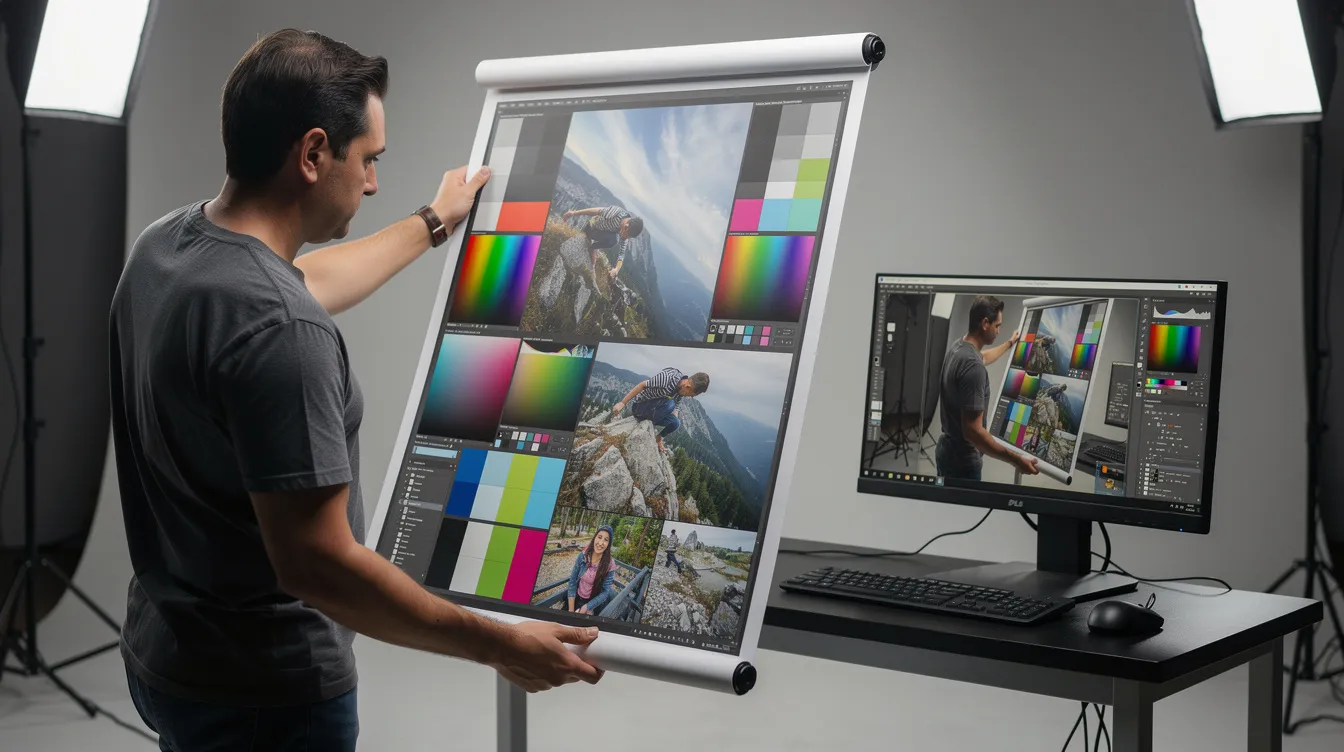
Comparing Online Photo Printing Services to Fine Art Print Labs
Consumer-focused online photo printing services do a perfectly reasonable job for everyday snapshots – birthday party prints, vacation photo albums, and casual photo gifts. Services like Nations Photo Lab use Silver Halide printing technology (which is over 100 years old) to produce great quality results. Some people recommend Nations Photo Lab for its breadth of print sizes and reliable turnaround. Mpix uses Kodak Endura paper for high-quality prints with rich colour. Printique offers a range of paper options including Fujifilm Matte for those who prefer a softer finish. These are all legitimate choices when you need good-looking prints in a timely fashion at accessible prices.
But consumer labs and fine art print labs serve fundamentally different needs. Here’s where they diverge:
- Paper and substrate depth. A consumer lab might offer three to five photo paper types. A fine art lab offers dozens, including cotton rag, baryta, metallic, and multiple weights and textures of professional-grade photo paper.
- Colour management support. Pro labs publish ICC profiles, accept soft-proofed files, and can work with photographers to match specific colour targets. Consumer web interface uploads rarely offer this level of control.
- Quality assurance. Fine art labs inspect prints visually under controlled lighting. Consumer labs rely on automated output with spot checks.
- Mounting and finishing. Pro labs offer canvas stretching, acrylic face-mounting, museum framing, and float hardware. Consumer labs may offer canvas prints and basic frames. Some offer canvas prints that can be wrapped around a wooden frame, but the substrate and ink quality may differ.
- Customization options. Fine art labs handle non-standard sizes, custom crops, and artist-directed adjustments. Consumer labs work within fixed templates.
Offset lithography delivers sharp text and consistent colour fidelity on large runs – useful for books and catalogues, less so for one-off wall art. For all wall art orders, Jardene Photography relies on a pro lab partner rather than mass-market printers, because the difference in print quality is visible and lasting.
When is a consumer online photo lab “good enough”? For casual prints, photo books, family photo albums, and gift ideas under $50. When is a fine art lab worth the investment? For hero pieces, collector editions, and any image that will anchor a room for years to come.
Common Print Defects and How High-End Labs Avoid Them
Knowing what can go wrong helps you appreciate what good print services prevent. Common defects in lower-end prints include:
- Banding. Visible horizontal or vertical stripes in smooth gradients (skies, water). Caused by clogged nozzles, low ink channels, or insufficient bit depth.
- Colour casts. An overall shift – too warm, too cool, too magenta – usually from missing or incorrect ICC profiles, or colour correction applied generically by automated software.
- Blocked shadows. Dark areas rendered as featureless black instead of showing subtle detail. Often the result of gamut clipping or under-profiled substrates.
- Soft focus. The print looks less sharp than expected. This can stem from low-resolution source files, over-applied noise reduction, or lens aberrations magnified at large print sizes.
- Physical damage. Scratches, dents, corner bends, and dust inclusions from poor handling and weak packaging.
High-end labs prevent these issues through calibrated printers, regular nozzle checks, visual inspection under standardized lighting, and comparison of the final print against the soft proof. At ArtBeat Studios, if a test run reveals even a slight colour shift, the print is rejected and reprinted. In one case during a 2024 production run, a subtle warm cast on a winter Rockies scene was caught during proofing and corrected before the final print was produced – a detail that would have gone unnoticed in an automated consumer pipeline.
If your prints arrived with any defect, a reputable lab should offer a reprint. And for Jardene Photography orders, the 100% Satisfaction Guarantee means issues are resolved directly.
Packaging, Shipping, and Why Protection Equals Quality
Highest quality printing doesn’t end when the ink dries. A flawless print that arrives with a dented corner or a crease across the sky is no longer a flawless print.
Jardene Photography prints are packaged through ArtBeat Studios with secure packaging designed for Canadian and international shipping. Paper prints ship in rigid tubes or flat between stiff boards with corner protectors. Metal and acrylic prints are crated with foam padding and edge protection to prevent transit damage. Protective wrap guards against moisture – important for Canadian shipments that may cross temperature extremes between warehouse and doorstep.
Large metal or acrylic prints require more substantial packaging, which influences both shipping cost and delivery time. Most wall prints ship within 7–14 business days depending on size and medium. The added cost of professional packaging is part of the quality equation, not an afterthought.
A practical tip: if you plan to move, loan prints to exhibitions, or store pieces temporarily, keep the original packaging. It’s purpose-built to protect that specific print and far better than improvised wrapping.
Longevity and Archival Ratings: How Long Will High-Quality Prints Last?
Archival permanence is tested by independent bodies that subject prints to accelerated light, heat, and humidity exposure, then project how long the print will resist visible fading under typical display conditions. Archival-quality photo paper preserves prints for decades when paired with the right inks. Archival-quality photo paper preserves images for decades, making it the foundation of any museum-worthy output.
Modern pigment-ink giclée prints on acid-free cotton rag or baryta papers are typically rated for 100–200+ years under ideal conditions – low UV exposure, stable humidity, and minimal airborne pollutants. Premium metal prints (dye-sublimation on ChromaLuxe) are rated for 65+ years. By contrast, inexpensive dye-based prints from consumer minilabs may show visible fading within 10–25 years under the same conditions – and much faster if hung in direct sunlight.
UV-protective glazing (museum glass or UV-filter acrylic) extends display life significantly for paper prints. For metal and acrylic pieces, keeping prints out of direct sunlight remains the simplest preservation strategy.
Jardene Photography selects print processes specifically for long-term stability. When you invest in a limited edition piece, you’re acquiring art that can be handed down – not something that will look washed out in a decade. Your memories deserve that kind of permanence.
High Quality Printing for Different Genres: Landscapes vs. Wildlife
Subject matter should drive print medium decisions. A sweeping landscape of the Canadian Rockies benefits from high contrast and saturated colour – glossy metal or acrylic face-mounts let those turquoise lakes and golden alpenglow sing. The extra micro-contrast of a glossy finish reveals snow texture on distant ridgelines, separates layers of mountain haze, and renders water reflections with almost three-dimensional depth.
Wildlife subjects tell a different story. A bison portrait with dense winter fur or a close-up of a grizzly’s face often looks more natural on matte cotton rag or baryta paper. The softer rendering flatters organic textures – individual hairs, feather barbs, the wet sheen of a nose. Glossy surfaces can make fur look plasticky and overprocessed.
Jardene often recommends different surfaces for different series: a winter bison collection may default to matte rag, while an aurora panorama gets the full glossy or acrylic treatment. For portrait style prints of wildlife, a textured matte finish almost always wins.
Viewing distance, room lighting, and décor style all factor in. A bright, modern loft with concrete walls suits a glossy metal print. A warmly lit study with wood shelving calls for a framed matte paper piece.
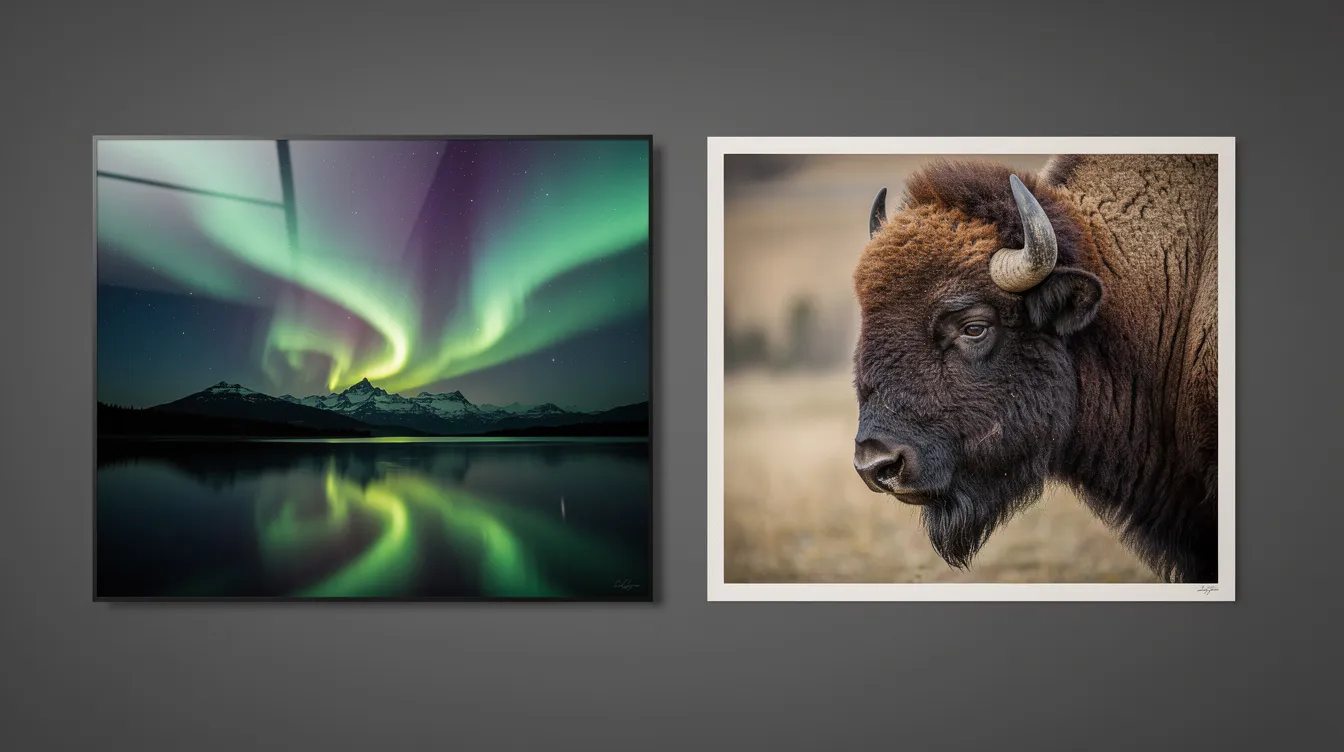
Selecting the Right Print Medium for Your Space
This is where printing decisions become interior design decisions. Here’s a room-by-room guide:
- Kitchen or entryway. Durable, moisture-resistant metal prints handle humidity and temperature swings without concern. Easy to clean with a soft cloth.
- Living room above a sofa. Framed fine art paper prints or acrylic face-mounts create a focal point. Choose size proportional to the wall – a 24×36″ or 30×45″ piece suits a wall that’s at least five feet wide.
- Bright, windowed spaces. Non-glare acrylic or matte finish paper reduces reflection. Glossy prints in rooms with large windows can become mirrors at certain angles.
- Hallways. Smaller framed prints in a series work well. Consider two sheets of related images – a matching pair of landscapes or a wildlife diptych – for visual rhythm along a corridor.
- Home office or study. Matte paper in an archival frame. Minimal glare under desk lighting, classic presentation.
Typical Canadian home environments – dry winters with forced-air heating, variable humidity in spring – can stress paper prints if framing isn’t sealed properly. Metal and acrylic are inherently more resilient to humidity fluctuations.
Jardene Photography can recommend ideal print size and medium for particular walls based on client photos and measurements. Reach out with pictures of your space, and we’ll suggest options.
Limited Edition vs. Open Edition: What Collectors Should Know
A limited edition print is produced in a fixed quantity – typically runs of 25, 50, or 100 – after which no more prints of that image at that size are made. Each is signed and numbered by the artist. This controlled scarcity supports long-term value and gives collectors confidence that the piece won’t be mass-produced.
Jardene Photography offers limited editions on key flagship images from iconic Alberta and Rockies locations. Edition tracking ensures integrity – records are maintained for every print sold, and the edition is closed once the run is complete.
Collectors evaluating fine art photography look at both artistic merit and technical printing quality before investing. A stunning composition printed on cheap paper with dye inks is a decoration. The same composition printed as a pigment giclée on archival cotton rag, properly framed and numbered, is an investment. The materials and process are part of what gives the piece lasting value.
Open edition prints – available without quantity limits – offer the same quality of materials and process at Jardene Photography. The difference is exclusivity and potential appreciation, not craftsmanship.
Working With a Photographer-Printer vs. DIY Upload Sites
When you upload photos to a generic online print service, you’re trusting an automated system to handle crop, colour, and output without any artistic context. The file goes in, the print comes out, and if the result is too dark, oddly cropped, or printed on an unsuitable surface, you discover that only after unboxing.
Working directly with a photographer who oversees the entire process eliminates those surprises. Andy Denton at Jardene Photography advises clients on crop, print size, surface, and hanging options – drawing on professional accreditation, including a Craftsman degree in Nature Photography and recognition at the 7th Fine Art International Photography Awards.
This collaborative approach avoids common disappointments: odd crops that cut into a foreground element, prints that arrive too dark because the lab’s auto-correction misjudged the exposure, or a glossy finish applied to a subject that needed matte. If you care about best quality results, ask the photographer about their lab, materials, and workflow before you order prints.
Photo Books vs. Wall Prints: Where Highest Quality Matters Most
Photo books and photo albums serve a different purpose than wall art. A photo book tells a story across sequential pages – it’s ideal for documenting a trip, building a portfolio, or creating a gift for loved ones. Consumer-grade photo books from major online services are affordable, well-bound, and perfectly adequate for family memories and favourite shots from a vacation.
True high-end photo books use fine art papers, lay-flat bindings, and pigment inks – and they’re priced accordingly. These are portfolio-grade products for professional photographers and collectors.
Jardene Photography focuses on wall art prints as the primary expression of highest-quality printing, because a single large print in the right medium can transform a room in a way that a book on a coffee table cannot. That said, collectors often start with a large wall print and later add smaller prints, a calendar, or a curated photo book to expand their collection. For storytelling and gift ideas, a premium layflat book is worth the investment; for everyday snapshots from a phone, standard online photo books deliver good value.
How to Prepare Your Own Files for High-Quality Printing
If you’re preparing your own digital photos for printing at a pro lab – not just ordering from Jardene’s catalogue – here are the essentials.
- Export at full resolution. Never downsize for print. Your print order should use the largest file your camera produces.
- Use TIFF or high-quality JPEG. TIFF preserves all data. If using JPEG, set quality to maximum (level 12 in Photoshop, 100% in Lightroom). Avoid sending social-media-compressed files or screenshots to any online photo printing service – the resolution and colour information have already been destroyed.
- Embed the correct colour profile. Adobe RGB or sRGB, depending on the lab’s requirements. ProPhoto RGB is powerful but must be converted carefully.
- Don’t over-sharpen. Apply output sharpening appropriate for the print size and substrate. Over-sharpening creates visible halos that ruin detail.
- Do a test print. Before committing to a 30×45″ metal print or acrylic, create a modest 12×18″ test at a high-end lab. Evaluate colour, contrast, and sharpness under the same lighting where the final piece will hang.
If in doubt, send the file to a knowledgeable photographer or print lab for review before ordering large. The cost of a test print is trivial compared to the cost of a large print that disappoints.
Budget vs. Best: When to Spend and Where to Save
Not every print needs to be gallery-grade. Here’s a realistic framework for prioritizing.
Spend on quality when:
- The image will be a hero piece in a main living space
- You’re giving art as a milestone gift (wedding, anniversary, retirement)
- The print is a limited edition you expect to hold long-term value
- You want a premium photo print that will still look excellent in 30 years
Save when:
- You need test prints or proofs before committing to a final version
- The prints are for temporary display (event signage, seasonal decor)
- You’re printing everyday snapshots for a casual gallery wall or scrapbook
A CAD $40 budget poster uses thin paper, dye inks, and no colour management – it may look acceptable from across a room, but up close, the difference from a CAD $450–$850 gallery-grade metal or acrylic print is obvious. The investment gap covers archival materials, pigment inks, colour-managed production, inspection, professional mounting hardware, and secure packaging.
Jardene Photography’s fine art prints range from approximately CAD $125 to $850 depending on size and finish, with prices listed on each product page. That range reflects real differences in substrate, process, and editioning – not arbitrary markup. Don’t sacrifice archival materials and accurate colour for small savings on a piece that will anchor your home for years.
Frequently Asked Questions About Highest Quality Printing
Will my print fade in sunlight? All prints are affected by UV exposure over time, but archival pigment prints on quality substrates resist visible fading for 60–100+ years under normal indoor display. Avoid hanging any print in direct sunlight. UV-protective glazing adds another layer of defence for paper prints.
Can I order a custom print size? Yes. Jardene Photography can accommodate non-standard dimensions for most images. Contact us with your wall measurements and desired aspect ratio, and we’ll confirm feasibility.
What if my wall is very bright with large windows? Choose a matte finish or non-glare acrylic to minimize reflections. Metal prints in matte also work well. Positioning the print on a wall perpendicular to the window rather than opposite it dramatically reduces glare.
How long will shipping take within Canada? Most wall prints ship within 7–14 business days from order confirmation, depending on size and medium. Local pickup is available in Calgary.
Do you ship outside Canada? Yes, Jardene Photography ships to select international markets. Shipping costs and timelines vary by destination. Contact us for a quote on international orders.
What if I’m not satisfied with my print? Jardene Photography offers a 100% Satisfaction Guarantee on show and online orders. If there’s a quality issue, we’ll work with you to resolve it – whether that means a reprint, exchange, or refund.
Can I see the print options before I commit? Visit the Photography Shop to browse all the services and printing options. Each product page lists available sizes, finishes, and the prices listed for each configuration.
For tailored recommendations – especially if you’re choosing between metal, paper, or acrylic for a specific space – contact Jardene Photography directly with your project details.
Bringing It All Together: Choosing the Highest Quality Print for You
The “best” print is never a single answer. It’s the intersection of image type, print medium, size, budget, and the room where the piece will live. A vivid aurora panorama demands different treatment than a quiet bison portrait. A bright modern kitchen calls for different materials than a dimly lit study. And a collector building a long-term collection has different priorities than someone looking for a beautiful piece of wall decor to create a welcoming room.
What stays constant is the standard. Highest quality printing is both technical and aesthetic – archival inks, calibrated colour, premium substrates, careful inspection, and presentation that protects the image for decades. When those elements align with the right subject and the right space, a photograph becomes something that stops you mid-step every time you walk past it.
Browse Jardene Photography’s curated collections – bison, aurora and night sky, Canadian Rockies landscapes – with these principles in mind. And when you’re ready, send us your wall dimensions and a photo of the space. We’ll recommend the ideal piece and print treatment to bring a piece of Alberta’s wild beauty into your home.